
A vulnerability scan passes. The code ships. Two days later, an attacker finds a way in. The scanner never saw the problem because the problem only existed in production.
This is the limit of pre-deployment security. SAST scans source code. SCA checks dependencies. Container scanners look at images. None of them watches what happens when the application runs.
Runtime protection fills this gap. It sits inside the running application or alongside it. It blocks malicious input. It stops exploit chains. It catches what scanners miss. The platforms below offer different flavors of runtime defense.
1. Aikido
Aikido protects running applications through Zen, an open-source in-app firewall. Zen embeds directly into the application and blocks attacks before they reach the database.
How Aikido stops attacks at runtime:
- Blocks SQL injections, command injections, path traversal attacks, and SSRF autonomously
- Rate limits specific API endpoints by IP or user
- Blocks specific users manually when needed
- Runs on the same server as the application with no extra infrastructure
Zen also prevents IDOR vulnerabilities by analyzing SQL queries at runtime. The firewall parses every query, checks for proper tenant filtering, and throws an error when a query misses a tenant_id filter. Developers can no longer accidentally ship cross-tenant access bugs to production.
The IDOR protection works across Node.js today. Python, PHP, Go, Ruby, Java, and .NET agents are coming soon. Setup requires one line of code to enable the firewall and one line per request to set the tenant context.
For teams looking for Snyk alternatives for cloud and runtime defense, Aikido combines pre-deployment scanning with active runtime protection. The Zen firewall is open-source and free to use.
Who it fits: Teams that want active runtime defense without managing separate WAF infrastructure.
2. Oligo Security
Oligo Security launched its Application Detection and Response platform in early 2026, adding real-time exploit blocking to its runtime sensor. The company’s Deep App Inspection now provides runtime call stacks for CVEs, showing security teams exactly when and where vulnerable code actually executes.

Instead of debating whether a CVE might be exploitable, teams see the full call stack with proof that the vulnerable function ran in production. One Oligo customer reduced their vulnerability backlog by over 99% by limiting focus only to issues with executed vulnerable code
How Oligo stops attacks at runtime:
- Deep Application Inspection observes actual code execution at the library and function level
- Vulnerable function enrichment identifies 1100% more vulnerable functions than any CVE advisory
- Runtime AI Security monitors AI models and agents for prompt injection and agent abuse
- CADR correlates application-layer exploits with workload-level threats
- Blocks malicious system calls while allowing normal application execution to continue
Oligo reduces vulnerability noise by 90-99% within 48 hours by filtering out code that never runs. A vulnerable function that never executes triggers zero alerts. The platform also detects malicious packages at runtime through continuous behavioral profiling.
For organizations seeking runtime protection in Snyk alternatives, Oligo offers active defense that traditional scanners cannot provide. The platform works especially well for Java legacy applications where patching is not an option.
Who it fits: Teams running production container workloads who want to stop chasing CVEs and start blocking real attacks.
3. Prisma Cloud
Prisma Cloud includes WAAS (Web Application and API Security), a runtime protection module for cloud-native applications. The platform defends applications without requiring code changes.

How Prisma Cloud stops attacks at runtime:
- Bot management with visibility and protection for known, unknown, and user-defined bots
- Application-layer DoS protection through rate controls
- 25 compliance checks mapped to CRI-O container runtime
- Deeper Kubernetes cluster awareness for runtime audits via cluster filters
- Custom compliance checks for operating systems and runtime configurations
The WAAS module works alongside Prisma Cloud’s Container Security and Host Security modules. For organizations already running Prisma Cloud for CSPM, enabling WAAS adds runtime protection without deploying new agents.
Pricing requires a sales call. Public numbers are not available. Enterprise deployments typically exceed six figures annually.
Who it fits: Enterprises already using Palo Alto Networks products that want integrated runtime protection without managing separate WAF infrastructure.
4. Acunetix
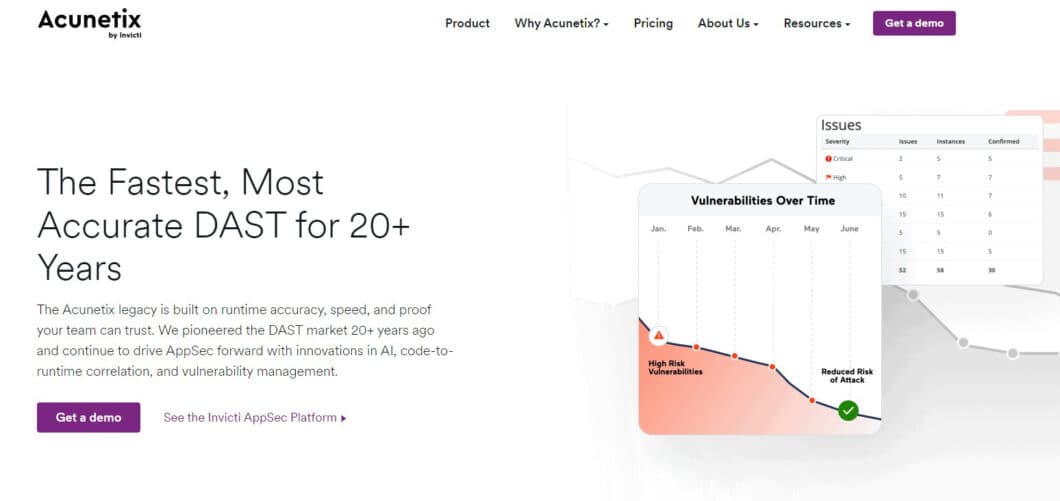
Acunetix brings runtime validation through its proof-based scanning technology. While traditionally a DAST tool, Acunetix’s approach to vulnerability confirmation sets it apart.
How Acunetix validates threats:
- Proof-based scanning attempts to exploit each found vulnerability
- 99.98% confirmation accuracy for exploitable vulnerabilities
- AcuSensor instrumentation runs inside the application to confirm backend responses
- Out-of-band detection for blind vulnerabilities like SQL injection
- Over 7,000 vulnerability checks, including OWASP Top 10
Unlike static scanners that report potential issues, Acunetix proves whether an exploit works. This validation happens at runtime against the live application. Teams receive confirmed findings instead of theoretical alerts.
Acunetix also scans OpenAPI, GraphQL, and SOAP APIs based on definition files from crawlers or manual upload. The scanner uses a built-in browser to navigate complex JavaScript applications and single-page apps.
Pricing starts at $4,500 per year for a single domain license. On-premise and cloud versions are available.
Who it fits: Security teams that want proof of exploitation before investigating alerts.
Why Runtime Protection Matters More in 2026
The average time to exploit a new vulnerability is now five days. Scanners that run weekly or even daily cannot keep up. Attackers move faster than pre-deployment checks.
Runtime protection catches what scanners miss. A SQL injection scanner tests for patterns. An in-app firewall like Aikido’s Zen blocks the actual attack when it happens. A vulnerable function that never runs produces zero alerts from Oligo.
The shift from detection to prevention changes the security equation. Instead of asking “is this vulnerable,” runtime protection asks “is this being attacked.” When an attack happens, the system blocks it immediately.
Embedded WAF vs. Network WAF
Traditional web application firewalls sit at the network edge. They inspect traffic before it reaches the application. This works but has limitations. Encrypted traffic needs SSL termination. Custom protocols may not be supported. Latency increases.
Embedded WAFs like Aikido’s Zen run inside the application. They see the actual data after decryption. They understand the application context. They can block specific users or rate limit endpoints by IP. Setup takes one line of code.
The trade-off is language support. Zen currently supports Node.js, with other languages coming. Network WAFs work with any application regardless of stack. The right choice depends on where the team has control.
Final Thoughts
Runtime protection changes the security workflow. Instead of fixing everything that might be vulnerable, teams block what actually gets attacked.
Aikido’s Zen firewall embeds directly into applications and blocks SQL injections, command injections, and IDOR vulnerabilities at runtime. The open-source agent installs with one line of code. For teams looking for runtime protection in Snyk alternatives, Zen adds active defense without managing separate WAF infrastructure.
Oligo observes production execution and blocks malicious system calls while keeping applications running. Prisma Cloud adds WAAS for enterprises already using Palo Alto products. Acunetix validates exploits before alerting, though it does not block attacks in-line.
Among all-in-one Snyk alternatives to consider, Aikido offers the most accessible path to runtime protection. Flat pricing covers pre-deployment scanning and active defense. One platform. One agent. Attacks stop at runtime.